Demonstrate compliance immediately
Accessibility Statement
We provide you with an Accessibility Statement to demonstrate compliance with applicable accessibility requirements and help reduce the risk of penalties and enforcement measures.
Do you have a truly accessible website?
Find out with us: we’ll solve your accessibility issues in 3 simple steps!
We offer a complete range of solutions and digital accessibility consulting support to assist you at every stage of the process.
We analyse your website
We carry out an in-depth analysis of your website to assess its actual level of digital accessibility.
We identify accessibility issues
We identify errors, assess compliance levels and manage accessibility attributes.
We make it accessible
We resolve accessibility issues and provide you with an Accessibility Statement aligned with applicable accessibility requirements.
The product
Accessibility Statement
The Accessibility Statement is a document used to communicate the accessibility status of a digital service and demonstrate alignment with applicable accessibility requirements, including the European Accessibility Act where relevant.
-
Demonstrate accessibility
-
Maximise your potential audience
-
Keep your touchpoints up to date
Security
Avoid penalties!
Publishing an Accessibility Statement not only demonstrates your commitment to accessibility, but can also help reduce the risk of penalties and enforcement measures resulting from accessibility compliance checks, where applicable.
-
Reduce the risk of financial penalties
-
Demonstrate your proactive approach
-
Support compliance requirements for public procurement opportunities

Delivery
Sample Statement
A sample Accessibility Statement will be available through our dashboard, prepared according to the most up-to-date and detailed accessibility guidelines.
-
Review the key elements
-
Use okDashboard to your advantage
-
Explore the current WCAG guidelines

Do you want a fully accessible website?
Take advantage of all our products working together!
Our work supports organisations looking for practical solutions to improve the accessibility of their digital services.
okDashboard
The most comprehensive platform for managing digital accessibility within your organisation. It provides quick and intuitive access to analyses and helps identify accessibility errors.
okWidget
A proprietary okACCEDO widget capable of independently addressing approximately 70% of the most common website accessibility errors and helping you resolve them.
Frequently asked questions
All the answers you’re looking for
An Accessibility Statement is an essential tool for assessing and communicating the accessibility status of websites and mobile applications in relation to applicable accessibility requirements and the current WCAG guidelines. It involves an accurate analysis of the characteristics and functionality of the digital interface in order to assess its level of conformity with recognised accessibility standards.
Why should the Accessibility Statement be kept up to date? Keeping accessibility information up to date not only promotes inclusion and equal access to online resources for all users, but also supports legal compliance and strengthens an organisation’s commitment to social responsibility.
Failure to comply with applicable accessibility requirements may result in legal or regulatory consequences, depending on the country, type of organisation and services involved. These may include financial penalties, enforcement action and requests to remedy accessibility issues within specified timeframes.
Under frameworks such as the European Accessibility Act, enforcement mechanisms and penalties are defined and implemented by the relevant national authorities. Their nature and amount therefore vary between jurisdictions.
For this reason, it is important to consider the Accessibility Statement requirements, deadlines and update procedures applicable to each organisation and market.
To prepare an accurate and transparent website accessibility statement, the first step is to analyse the actual accessibility status of the relevant touchpoint, carefully identifying areas of non-conformity that should subsequently be documented according to the applicable accessibility framework.
Once critical issues have been identified, a remediation plan should be developed to remove accessibility barriers by applying recognised best practices and internationally accepted standards.
During this process, it is essential to involve accessibility experts, such as okACCEDO, to ensure a complete and accurate analysis. Finally, the Accessibility Statement should be drafted clearly and comprehensively, including all the information needed to provide a transparent and reliable assessment of the accessibility level of the service or product concerned.
To complete a website Accessibility Statement correctly, all the results obtained from the audit should be described so that any areas of non-conformity are communicated transparently.
This allows the organisation responsible for the interface to understand its accessibility status and be prepared to implement the necessary corrective actions. It is a fundamental step towards ensuring that a website is accessible to all users.
The publication and updating requirements for an Accessibility Statement depend on the accessibility framework applicable to the organisation, service and market concerned.
Where publication is required under frameworks such as the European Accessibility Act or other applicable accessibility rules, organisations should ensure that the statement is made available through an appropriate and easily accessible digital channel and kept up to date in accordance with the relevant requirements.
For websites, the statement can generally be made easy to find through a clearly identifiable link. For mobile applications, accessibility information should be provided through an appropriate location that is readily available to users.
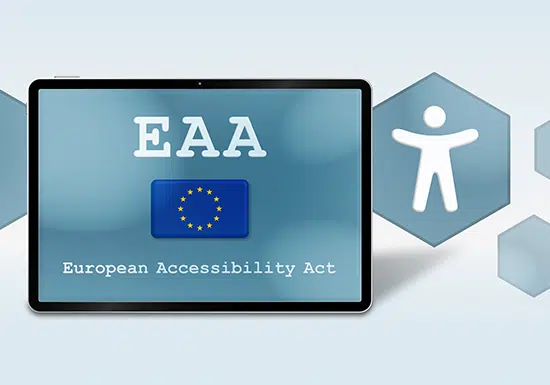
The European Accessibility Act is the European framework designed to improve the accessibility of certain products and services for people with disabilities across the European market.
It establishes accessibility requirements for products and services that fall within its scope, encouraging more consistent accessibility across digital services and supporting a more inclusive environment.
For organisations operating internationally, its applicability should always be assessed according to the services offered, the markets in which they operate and the relevant local implementation framework.
The Web Content Accessibility Guidelines (WCAG) provide an internationally recognised technical framework for improving the accessibility of websites and other digital interfaces.
They define principles, success criteria and techniques designed to make digital content more perceivable, operable, understandable and robust for people with different disabilities and assistive technology needs.
Using the current WCAG guidelines helps organisations identify accessibility barriers, plan remediation activities and develop more inclusive digital experiences.
Digital accessibility guidelines cover several aspects of websites, applications and other digital interfaces.
They include requirements relating to content perception, keyboard navigation, colour contrast, text alternatives for images, forms, multimedia content, interface structure, compatibility with assistive technologies and overall usability.
Depending on the applicable legal framework, additional requirements may apply to specific products, services or sectors. The goal remains the same: to encourage the adoption of accessible standards and best practices and enable as many people as possible to use digital services independently.